Public source stream

Aggregates

The newsroom’s collected links, newest first. Read-only and unreviewed; stories saved by the desk appear in EchoNews.
10 shown // 378 collected items // Newest first Back to newest
Chatham House What's New //

After Trump’s midterm defeat, Russia and China will encounter a cooler US

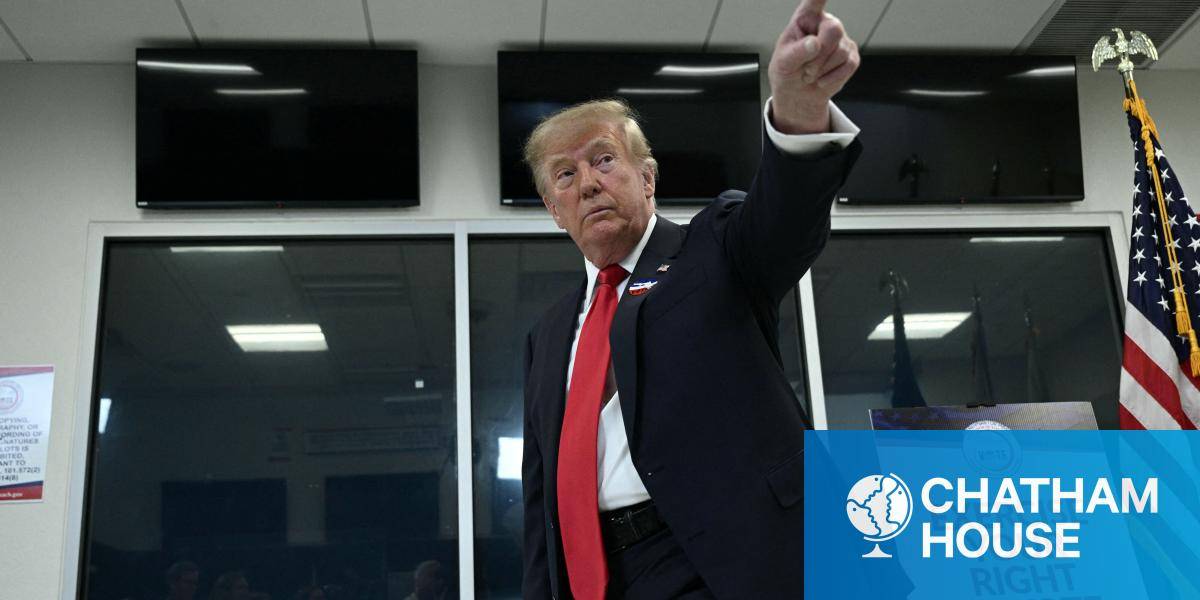
After Trump’s midterm defeat, Russia and China will encounter a cooler US Expert comment jon.wallace 5 November 2026 They may seek to exploit the president’s weakness, as domestic opposition to war with Iran hardens. The comprehensive rebuff that American voters have given to President Donald Trump and Republican candidates in the midterm elections is likely to produce a small but important constraint on how the US behaves abroad. But it will also change how other countries treat it – allies, trading partners and rivals alike. Even with the Democrats in control of both the House of Representatives and the Senate, the president retains much power over foreign policy – but not all. Congress is now likely to challenge any sustained deployment of forces in the Gulf. And it will reassert its authority over trade and tariffs, even if it does not amend the latter. Hear directly from the experts Get nuanced insights from Chatham House experts on the issues shaping the global policy and geopolitical landscape. The most immediate change is likely to be on the conflict with Iran . Voters put the cost of living – ‘affordability’ – top of their concerns. Yet, as they went to the polls, gasoline prices at the pump hit a high. Rising costs are largely a result of the continued conflict in and around the Strait of Hormuz, which Americans know Trump initiated alongside Israel and has failed to end. Trump could now indeed ‘lash out’ as some have predicted with more strikes, in an attempt to secure concessions from Tehran. But there is no reason to believe that a military solution will fare any better than before. The Republican party has been among the biggest losers from the war. The race for the presidency in 2028 started the moment the midterm results became clear. And GOP candidates are likely to be vehemently against continuing the conflict. Pressure within the US for a resolution will rise even if Benjamin Netanyahu, now Israel’s caretaker prime minister after his own electoral


Geopolitical Analysis
Chatham House What's New //

‘Very clear that China isn’t neutral’ in Ukraine war, says former Ukrainian Prime Minister Arseniy Yatsenyuk

‘Very clear that China isn’t neutral’ in Ukraine war, says former Ukrainian Prime Minister Arseniy Yatsenyuk News release thilton.drupal 5 November 2026 Speaking at a public event at Chatham House, Yatsenyuk also suggested it was unrealistic that Ukraine could regain territory ‘right now’ and called for additional financial support. Ukraine’s former prime minister Arseniy Yatsenyuk said that Chinese support for Russia was helping it to continue the Ukraine war as he discussed the war’s trajectory at Chatham House on Tuesday 3 November. Yatsenyuk said that while the Russian economy is in a ‘dire state’, Russia’s president Vladimir Putin still has ‘enough resources to prosecute the war.’ He said the reasons for this included higher oil prices due to the Iran war and Chinese support for Russia. Yatsenyuk said: ‘I want to be very clear that China isn’t neutral. China actually supports this war, and China is an ally to Russia. Let’s call a spade a spade. I do understand that it’s around 1.5 billion of people, nukes, a huge global powerhouse. But the truth is that China is actually the closest strategic partner to the Russian Federation, and China provided the way to circumvent sanctions for Russia.’ He also said: ‘There is no clear evidence that China provides weaponry to Russia, but there is no doubt that China provides dual-use materials to Russia.’ Asked which side would break first in the conflict, he said that he believed Russia would ‘back down’ eventually if various developments took place, including Ukraine receiving more financial support from the European Union. He said Ukraine was facing a ‘huge budgetary gap’ of around €70 billion for the next year, with around €40 billion of this needed for ammunition. <div data-video-embed-field-lazy="<div class="video-embed-field-provider-youtube video-embed-field-responsive-video"><iframe width="854" height="480" frameborder="0" allowfullscreen="allowfullscreen" referrerpolicy="strict-origin-when-cross-origin" loading="la

Geopolitical Analysis
Chatham House What's New //

What will historic US midterm results mean for the future of Democrats and Republicans?

What will historic US midterm results mean for the future of Democrats and Republicans? Expert comment LToremark 5 November 2026 After a huge win for Democrats, both parties now face a reckoning as they prepare for the 2028 presidential race – and the post-Trump era. American voters delivered a resounding victory for Democrats in the 2026 midterms, the scale of their win surpassing all expectations. With control of both chambers of Congress – the House of Representatives and the Senate – Democrats will now preside over powerful tools of investigation and oversight, federal spending constraints and the ability to block Trump’s nominees, including for Supreme Court vacancies. President Trump will remain an enduring presence into the 2028 election cycle, especially on matters of foreign policy. But attention will increasingly move to his potential successors and the parties’ respective visions for the future. How – and whether – Democrats and Republicans use the two years ahead to constrain Trump’s widely unpopular foreign policy and define a clear alternative will determine both their success in claiming the White House and in shaping the global landscape its next resident will inherit. Related work Trump is set to redefine the lame duck presidency Both parties now face a reckoning, with consequential choices ahead on the key issues to prioritise, the ideological purity tests they may seek to impose and the presidential candidate they nominate for 2028. Democrats face a competitive primary season for the first time in eight years. This offers an opportunity for genuine debate but also risks stoking significant infighting. Moderates and conservative Democrats gained significant ground in traditionally Republican bastions. Progressives also notched key victories – from Abdul El-Sayed in Michigan to Alexandria Ocasio-Cortez’s (AOC) re-election in New York City. But the incoming Democratic caucus will hold very diverse views on issues like the US relationship with Israel,

Geopolitical Analysis
War on the Rocks //

The Golden Dome Proposal is Destabilizing and Dangerous

Editor’s Note: This is the second article in a two-part series exploring the Golden Dome for America proposal. Please also read the first, “Golden Dome Is Technologically and Financially Infeasible.”Golden Dome is an ambitious proposal for a comprehensive, layered defense, with ground, sea, and space-based elements. It is supposed to protect the United States, its allies, and deployed forces from attacks by ballistic missiles, cruise missiles, hypersonic boost-glide vehicles, aircraft, and drones launched by any adversary, including peer adversaries. The Golden Dome executive order also mandates further development of capabilities to defeat an adversary’s missiles before they are launched.A key The post The Golden Dome Proposal is Destabilizing and Dangerous appeared first on War on the Rocks .

Geopolitical Analysis
War on the Rocks //

Who Repairs the Internet in Wartime?

In spring 2026, Britain, Norway, and the United States tracked and disrupted a covert Arctic exercise off the coast of Norway involving Russian deep-sea submersibles simulating the deployment of a weapon designed to disable the two 1,400-kilometer submarine cables linking the islands of Svalbard to mainland Norway. Svalbard hosts a satellite ground station serving Europe, the United States, and Japan. This encounter revealed that NATO allies can detect a covert subsea operation and, if caught in time, disrupt it.Had it been a real attack, the first question would have been where and how quickly internet and sensitive government traffic could The post Who Repairs the Internet in Wartime? appeared first on War on the Rocks .

Geopolitical Analysis
Chatham House What's New //

Europe Elects: What does 2027 have in store for Europe?

Europe Elects: What does 2027 have in store for Europe? 21 January 2027 — 18:00 TO 19:00 GMT Anonymous (not verified) 4 November 2026 Chatham House and Online As Europe enters a pivotal election year, join us at Chatham House for Europe Elects , a series exploring how the results might reshape the continent. As Europe enters a pivotal election year, join us at Chatham House for Europe Elects, a series exploring how the results might reshape the continent. Europe enters 2027 with political change in the wind, as elections test established parties and reshape debates over defence, migration, competitiveness and other issues. The results will reveal shifts in voter priorities and offer a window into political forces shaping Europe’s future. This event discusses: Which elections could have the greatest impact on Europe in 2027? What do changing voter priorities reveal about European politics? Can established parties respond to growing electoral pressure? How could elections reshape policy on defence, migration and the economy? What do national political shifts mean for European integration? What will 2027 reveal about Europe’s longer-term political direction? Will far-right parties lose momentum after Trump’s midterm defeat?

Geopolitical Analysis
War on the Rocks //

Why Are Wars Increasingly Difficult to End?

The number of armed conflicts has increased in recent years, and researchers have warned that many wars are lasting longer and have become more difficult to end. We asked five experts if the 21st-century trend of more intractable wars is continuing, and if so, why.Read more below.Dafna H. Rand Senior Fellow at Brookings Former U.S. Assistant Secretary of State Wars are not ending definitively in the 21st century, and the United States is likely to see the same pattern in Iran. Whereas peace settlements or victory by one side was once the culmination of war, today the more likely scenarios The post Why Are Wars Increasingly Difficult to End? appeared first on War on the Rocks .

Geopolitical Analysis
War on the Rocks //

The Army’s Command-and-Control Reboot

How the Army makes decisions, communicates orders, coordinates forces, and keeps operations moving toward a common goal is undergoing a revolution. It’s called Next Generation Command and Control. Two of its architects — Lt. Gen. Matthew W. McFarlane, commanding general of I Corps, and Maj. Gen. Patrick J. Ellis, commanding general of the 4th Infantry Division — joined us to discuss this important set of organizational and technological innovations.Our thanks to AeroVironment for sponsoring the event at which this episode was recorded.Image: Kathryn Bailey via DVIDS The post The Army’s Command-and-Control Reboot appeared first on War on the Rocks .

Geopolitical Analysis
Chatham House What's New //

Trump is set to redefine the lame duck presidency

Trump is set to redefine the lame duck presidency Expert comment jon.wallace 4 November 2026 Conventional wisdom says the Democrats in Congress will now constrain the president. Nobody told President Trump. Although Donald Trump’s name was not on any ballot this week, American voters viewed the 2026 midterm election cycle as a referendum on his presidency. With the votes counted the message Americans delivered to the president is clear: they do not approve. They don’t approve of the cost of petrol at the pump, they don’t approve of the state of the US economy, and they don’t approve of the war with Iran. Having lost control of both congressional houses, conventional wisdom would dictate that the executive branch should be hampered for the remainder of Trump’s second term. But the president has never operated by the rules of conventional wisdom. We should not expect Trump to recede into the background. And this is not (yet) the end of the Trump era. Like so many facets of American politics over the past decade, Trump is set to redefine the lame duck presidency. With midterm elections behind him, the president can now (re)turn to what he cares about most: his legacy. A foregone electoral conclusion It has been clear for months that Trump was resigned to the prospect that the midterms would not go well. Republicans hoped the president would demonstrate discipline on top issues for US voters : the economy, affordability, and the cost of living. Instead, he spent the run-up to the elections preoccupied elsewhere. He picked a fight with Canada that very few at home understood. He found no exit ramp for a conflict in the Middle East that has driven up global energy pricing and hit American pocketbooks. And he reached a deal with Russian President Vladimir Putin to purchase millions of tons of Russian diesel, ostensibly to ease the pressure valve on energy costs at home but in practice befuddling many. As a result, and to some extent due to Democratic party momentum, Republ

Geopolitical Analysis