# EDITOR'S NOTE: I’ve been gone for a while.
Not gone in the dramatic, final-curtain sense. Gone in the American sense: hustling, scrambling, trying to find a way out of my own mess before the walls got any closer. Truth be told, there really isn’t much I can say here that I’m not already saying on other platforms. The platforms change. The algorithm changes. The bills do not.
So why am I back?
I’m moving back to Philly. I don’t have a choice. Things are what they are.
But, Gary, IN made me come to my senses. I'm on a fuckin' tear. May as well start with the obvious. And with that, let's set the scene in America's Heartland.
I'll see you again someday, Indiana.
# END NOTE
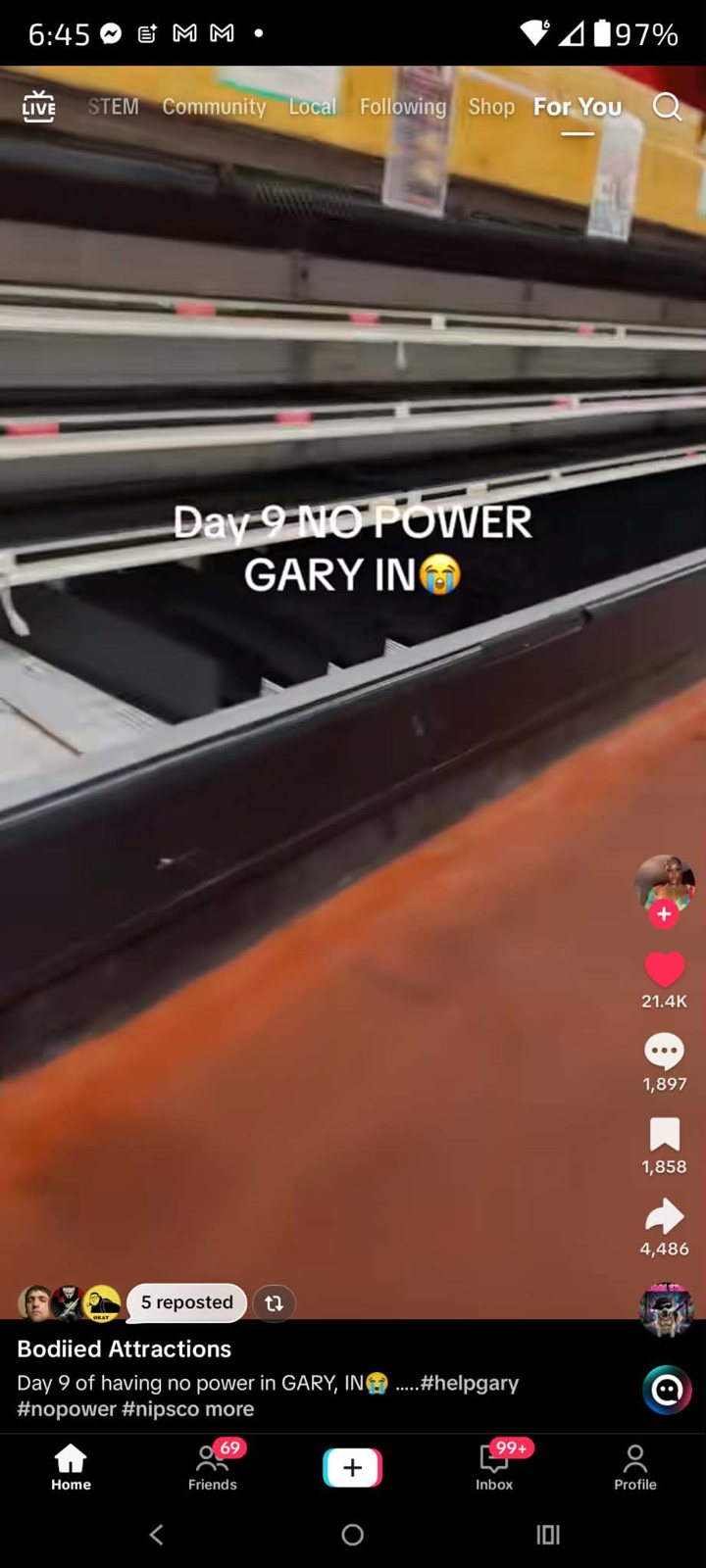
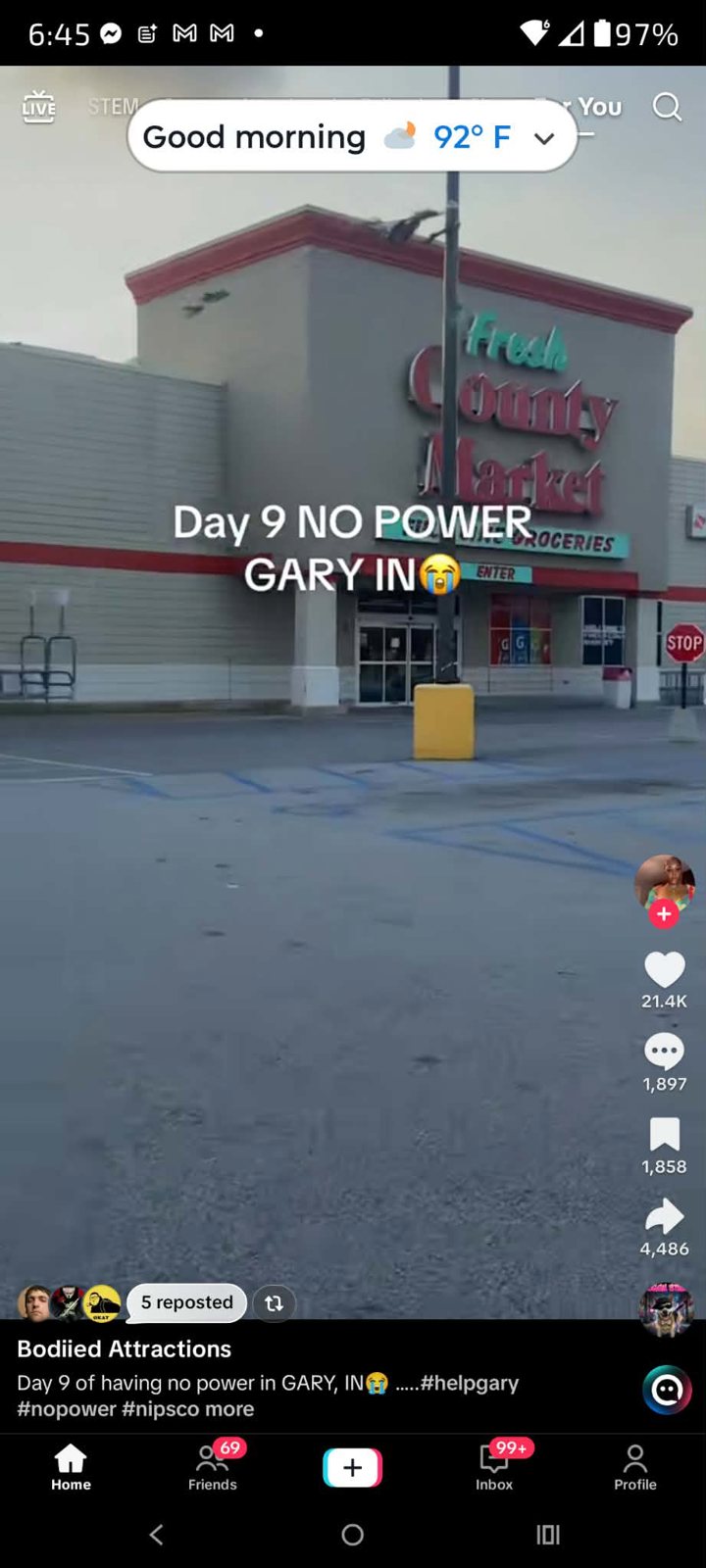
But, not any time soon, because as of Saturday morning, August 22, Gary, Indiana is not out of the dark yet.
Some power has come back. Some people can finally open a refrigerator without smelling the last week of their life rotting in it. But for thousands of households, the outage continues, and NIPSCO’s own restoration map still lists Gary and Portage for full restoration by Tuesday, August 25, at 11:59 p.m.
That means this is not just an outage. This is an endurance event.
The storm hit Northwest Indiana on August 11 with brutal force, including reported winds near 99 mph. NIPSCO says the damage required major rebuilding, including hundreds of poles. At the peak, hundreds of thousands of customers were knocked offline. By this week, Gary still carried more than 20,000 outages, making up a huge share of the remaining crisis across the region.
Those are the numbers. But numbers do what numbers always do: they behave. They sit there in clean rows and let people pretend this is manageable.
Here is what it means on the ground.
It means medicine warming up on the counter. It means insulin, oxygen machines, CPAP devices, refrigerated prescriptions, all suddenly dependent on luck, neighbors, batteries, and whether somebody down the block has a generator.
It means no normal breakfast. No laundry. No easy shower. No reliable phone charge. No cold water waiting in the fridge. No quiet hum of the house telling you the world is still basically functioning. It just...
...stops.
It means parents trying to keep children calm in hot, dark rooms. It means elderly people waiting for the grid like it is a rescue boat. It means every errand becomes strategy. Every outlet becomes a resource. Every gallon of gas becomes a question. Every unopened door to the refrigerator becomes a little funeral for groceries people could not afford to lose.
And yes, it is 2026 in the United States of America, and people are worrying about water, food, medicine, cooling, charging, transportation, school closures, lost wages, lost business, and how long they can keep improvising before improvisation becomes collapse.
This is the part we need to understand: disasters do not create inequality from nothing. They reveal it. They turn the lights off and show us who had backup systems and who was told to “be patient.”
Gary has been told to be patient for a long time.
When the power goes out in a place already carrying the weight of disinvestment, neglect, aging infrastructure, and political abandonment, it is not just weather. The storm may knock down the line, but history decides who waits longest for it to be repaired.
And while Gary waits, the national attention machine is off somewhere else, chasing whatever spectacle has been fed into it today. Iran. Trump orbit gossip. Washington palace drama. The loudest nonsense available. Meanwhile, people are standing in line for meals, trying to keep phones alive, trying to keep food safe, trying to get through one more night.
This is not glamorous suffering. It is not a cinematic blackout with candles and moody piano music. It is boring, expensive, humiliating, dangerous, and exhausting.
And it should scare people outside Gary, too.
Not because Gary is uniquely doomed, but because Gary is a warning. The engine is rattling. The institutions are not fully collapsed, but you can hear the strain. A grid built for yesterday’s weather meets today’s climate. A political culture that mocked preparedness meets the bill for neglect. A country that treats infrastructure as background scenery suddenly discovers the background is what holds the whole stage up.
Conservative leadership did not invent thunderstorms. But it did help build a public reality where climate risk was treated as hysteria, regulation as tyranny, investment as waste, and basic public capacity as something to sneer at until the moment you need it.
Then everyone acts shocked as shellfish when the system buckles. (That... was a shitty euphemism. But, I stand by it.)
Gary is not asking for pity. Gary is asking for power. For competence. For urgency. For a country that can tell the difference between a headline and a crisis.
So no, the Gary outage is not “over” just because some lights are back on. It is not over for the people still waiting. It is not over for the businesses counting losses. It is not over for the families replacing groceries. It is not over for anyone who now knows, in their bones, how fast ordinary life can stop.
Stay strong, Gary.
And to everyone watching from somewhere the lights still work: this is your warning, too.
And as a personal matter, why aren't the remaining Jacksons helping out? Seems like something Michael would have. My opinion.