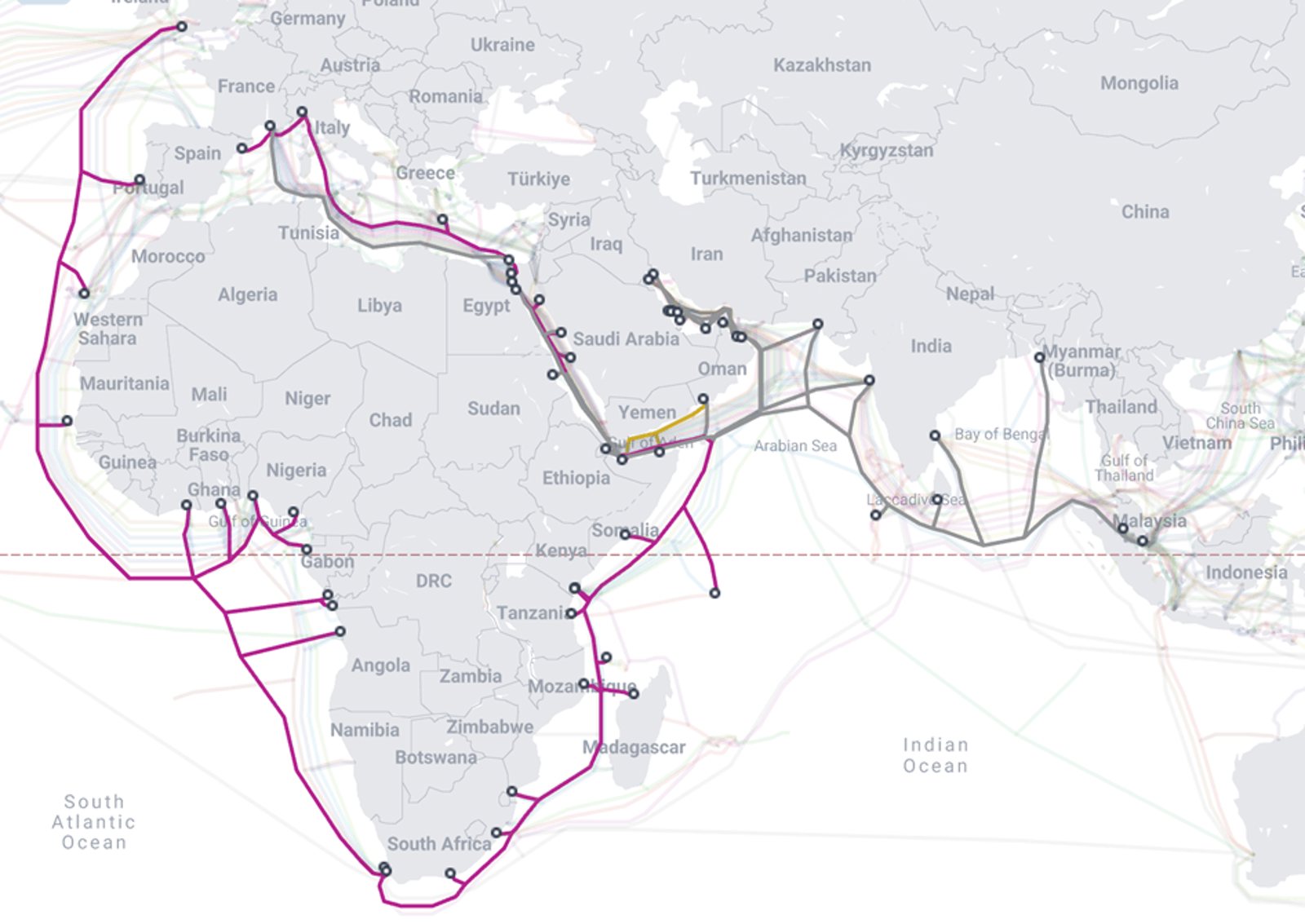
No, five cable segments in the Strait of Hormuz are not the planet’s single red extension cord.
A note before we begin: I know I haven’t posted very often lately. Life has been busy in the way life gets busy when it stops asking permission. My family has needed more of my time, and they come first. A few projects I’ve been grinding away at have also started bearing fruit, which is a welcome change from watering dirt and screaming at clouds. The hustle continues. The machine is moving. And here we are.
Let’s do this.
There is a bogus claim ricocheting around the American internet that Iran is going to “cut the cables under the water in the Strait of Hormuz and kill the internet.”
You can’t even finish reading the stupid before you start choking on it. It’s that rich.
Now, to be precise, Iran really has pointed to submarine cables in the Strait of Hormuz as vulnerable infrastructure. That part is real. The part where somebody snips five lines beneath the Gulf and Earth immediately loses email, banking, pornography, and Facebook access is the bullshit mushroom that grew out of it.
At least in the American feeds I’ve been wading through, the theory is spreading because of the Boomer–Gen Z media-literacy cage match we have going on in these great United States of America. One generation thinks the internet is the blue E they used to click. The other thinks it is three apps, a ring light, and whatever a man shouting from the driver’s seat of a Dodge Ram says happened this morning.
Between them sits the modern information economy: an unattended gas-station bathroom where every wall says BREAKING, nobody can find the sink, and one lunatic is explaining telecommunications with an oil-shipping map.
Yes, there are submarine cables in the Strait of Hormuz.
Congratulations. The rumor has successfully located one true noun.
According to the International Cable Protection Committee’s May 2026 update, five active submarine-cable-system segments traverse the strait. They matter to Gulf connectivity. Damaging them could cause serious outages, congestion, and economic disruption for countries and networks that depend heavily on those routes.
But the bandwidth crossing Hormuz represents less than one percent of international bandwidth worldwide.
Not half.
Not most.
Not “the internet.”
Less than one percent.
The ICPC characterizes the threat as regional rather than global. The Gulf also has terrestrial links, branching cable systems, and alternate routes capable of carrying at least some rerouted traffic.
That does not mean nothing would happen.
Plenty would happen.
Some Gulf users could lose service. Other connections might slow to a crawl. Video calls would turn into hostage photographs. Corporate VPNs would begin wheezing like an asthmatic accordion. Somebody downloading a 90-gigabyte video-game update would watch the estimate change from “forty-two minutes” to “during the reign of your eldest surviving heir.”
That is disruption.
It is not the death of the internet.
The internet is not one garden hose running beneath Iran with a yellow tag reading:
DO NOT CUT — CONTAINS ALL GLOBAL COMMERCE AND EVERYONE’S RACIST UNCLE.
It is a network of networks: submarine fiber, terrestrial fiber, exchange points, private backbones, data centers, local caches, and routing systems built specifically so that one broken path does not automatically take the whole thing down.
Globally, the submarine network consists of roughly 500 cable systems and about 1.8 million kilometers of cable. Around 150 to 200 submarine-cable faults occur every year. Roughly 70 to 80 percent are caused by ordinary human activity—especially fishing and ship anchors—rather than a supervillain in a minisubmarine carrying bolt cutters.
Most of these incidents do not become civilization-ending news because operators reroute traffic and repair the damage.
This is what the “Iran kills the internet” crowd does not understand:
Routing is a verb.
When one road closes, the traffic does not evaporate into the spirit realm. It tries another road. That road may be longer. It may be crowded. It may be held together by old contracts, emergency capacity, nervous engineers, and the telecommunications equivalent of duct tape.
But packets are shameless little bastards. They do not care whether the route is elegant. They care whether a route exists.
Could a massive, coordinated loss of submarine infrastructure cause worldwide trouble?
Absolutely.
Take out enough independent routes across several oceans and international service could become slow, unreliable, and fractured. Some countries could be hit brutally. Overseas cloud systems might fail while domestic websites keep working. The global internet could break into regional islands glaring at one another across the sea like divorced parents at a school recital.
But that requires a sprawling, multi-ocean catastrophe—not five cable-system segments at Hormuz having the worst Tuesday of their lives.
Even then, “the internet” would not vanish as one unified object. Local networks would still exist. Domestic services could still operate. Cached content would remain in regional data centers. Internet exchanges could continue moving local traffic. Your router would not burst into flames and confess its sins.
The likely result would be a fragmented internet, not no internet.
Then comes the inevitable follow-up:
“What about Starlink?”
No. Cutting a fiber-optic cable on the seabed does not also cut a satellite in orbit. The knife does not continue upward through several hundred kilometers of atmosphere like God’s own box cutter.
Satellite internet could preserve critical connectivity because the customer’s first hop is by radio rather than through the damaged seabed route. But satellite is not magic sky-fiber. It still has finite spectrum, finite satellite capacity, electrical requirements, user-terminal requirements, and a need to reach terrestrial networks somewhere before it can deliver the ordinary internet.
A 2026 study modeled low-Earth-orbit constellations as national emergency backups during submarine-cable outages. It found that LEO networks could replace only a small fraction of the lost capacity in the six countries studied. In four of the six, modeled recovery was below 15 percent.
That is enough to matter enormously for hospitals, emergency services, governments, journalists, businesses, ships, and households already equipped with terminals.
It is not enough to move an entire region’s normal fiber and cellular traffic into space overnight. Millions of users cannot simply stampede onto Starlink like Walmart has opened one final register before the apocalypse.
So, yes: submarine cables in Hormuz are real.
The regional risk is real.
Repairs during a war could be delayed by mines, permits, insurers, and the understandable reluctance of repair crews to sail directly into Hell’s own customer-service queue.
But “Iran can cut the cables and kill the global internet” is not serious analysis.
It is maritime fan fiction for people who think every line on a map is one extension cord and every extension cord leads directly to their Roku.
The internet is vulnerable. It is also distributed, redundant, ugly, improvised, and remarkably difficult to kill all at once.
Much like humanity, except with better documentation.
The actual danger is regional outages, overloaded alternate routes, disrupted banking and cloud access, economic damage, and delayed physical repairs during conflict.
That is bad enough.
We do not need to inflate it into:
THE OCEAN CABLE HAS BEEN CUT. PLEASE PRINT YOUR MEMES BEFORE MIDNIGHT.
Grab a drink.
The cables are real.
The danger is real.
The claim is still bullshit.
Bibliography
International Cable Protection Committee. “Media Enquiries & Frequently Asked Questions.” Updated May 20, 2026. Contains the figures for the five active cable-system segments in Hormuz, the corridor’s share of worldwide international bandwidth, global cable-system length, annual fault frequency, common causes of damage, and regional rerouting options.
Read the ICPC source International Cable Protection Committee
Maccioni, Federico. “The Hormuz Digital Chokepoint: How Does the Iran War Threaten Subsea Cables?” Reuters, April 28, 2026. Covers Iran’s public warning about cable vulnerability, the regional systems involved, terrestrial alternatives, repair difficulties during conflict, and the inability of satellite systems to replace submarine-cable capacity at scale.
Read the Reuters report Reuters
Bhosale, Vaibhav. “Are LEO Networks the Future of National Emergency Failovers?” Internet Society Pulse, February 5, 2026. Summarizes modeling of low-Earth-orbit satellite systems as national backups following submarine-cable disruptions, including the finding that four of the six studied countries recovered less than 15 percent of lost capacity.
Read the Internet Society analysis pulse.internetsociety.org